Registration algorithm: sct_register_to_template -lrootlet
Traditional template-based registration of the spinal cord uses intervertebral discs for alignment. However, substantial anatomical variability across individuals exists between vertebral and spinal levels. Spinal nerve rootlets, which are more consistent across individuals, can be used instead to improve registration accuracy (Bédard et al., 2025).
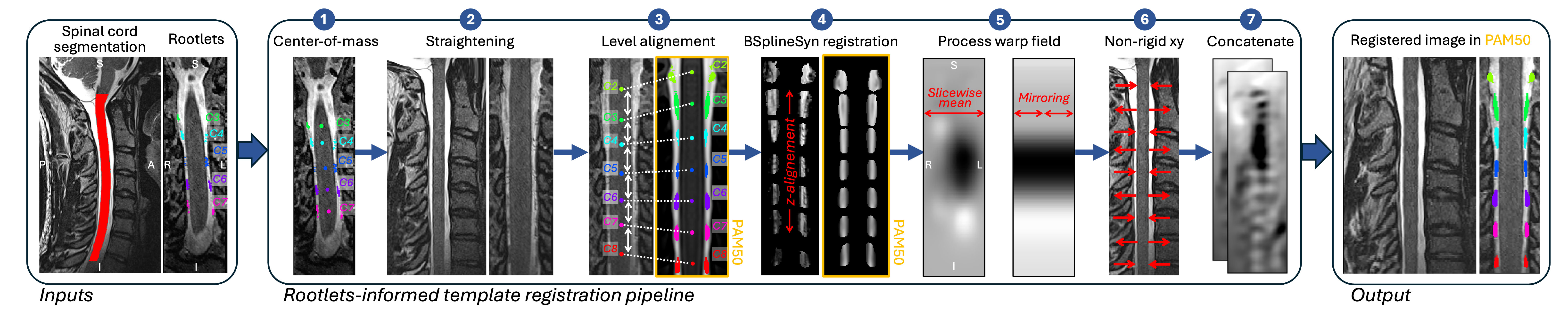
Rootlets-based registration pipeline.
SCT provides template registration based on spinal nerve rootlets using the -lrootlet argument of the sct_register_to_template command. Here are the steps for the algorithm within this command:
Center-of-mass calculation: The center-of-mass of each segmented rootlets level is computed for the subject native image and for the PAM50 template.
Straightening: The straightening works by finding, for each point along the spinal cord, the mathematical transformation to go from a curved centerline to a straight centerline.
Initial alignment of rootlets levels: Once straightened, the next step involves a transformation to match the center-of-mass of the rootlet levels of the subject to that of the template.
Non-linear registration in rostro-caudal axis: BSplineSyn registration is applied along the rostro-caudal axis using the rootlet segmentation as a mask on both subject and PAM50 T2w images to refine the z alignment. The parameters of the registration can be customized using the flag -param type=rootlet.
Processing of warping field: The resulting warping field from the rostro-caudal alignment (step 4) is averaged slice-wise to ensure right-left symmetry (step 5). The mean is calculated excluding zero values.
Shape-matching transformation: A multi-step nonrigid deformation is estimated to match the subject’s cord shape to the template. By default, two steps are used: the first handles large deformations, while the second applies fine adjustments.
Warping field concatenation: The forward and backward transformations to the PAM50 template are generated by concatenating the warping fields from steps 2, 3, 5 and 6.
Tip
You can visit the Customizing the registration command page to learn how to optimize the registration procedure for your particular contrast, resolution, and spinal cord geometry.