sct_deepseg_sc
Command-line usage
Spinal Cord Segmentation using convolutional networks. Reference: Gros et al. Automatic segmentation of the spinal cord and intramedullary multiple sclerosis lesions with convolutional neural networks. Neuroimage. 2019 Jan 1;184:901-915.
usage: sct_deepseg_sc -i <file> -c {t1,t2,t2s,dwi}
                      [-centerline {svm,cnn,viewer,file}]
                      [-file_centerline <str>] [-thr <float>] [-brain {0,1}]
                      [-kernel {2d,3d}] [-ofolder <str>] [-o <file>] [-qc <str>]
                      [-qc-dataset <str>] [-qc-subject <str>] [-h] [-v <int>]
                      [-r {0,1}]
MANDATORY ARGUMENTS
- -i
Input image. Example:
t1.nii.gz- -c
Possible choices: t1, t2, t2s, dwi
Type of image contrast.
OPTIONAL ARGUMENTS
- -centerline
Possible choices: svm, cnn, viewer, file
Method used for extracting the centerline:
svm: Automatic detection using Support Vector Machine algorithm.cnn: Automatic detection using Convolutional Neural Network.viewer: Semi-automatic detection using manual selection of a few points with an interactive viewer followed by regularization.file: Use an existing centerline (use with flag-file_centerline)
Default:
'svm'- -file_centerline
Input centerline file (to use with flag
-centerlinefile). Example:t2_centerline_manual.nii.gz- -thr
Binarization threshold (between
0and1) to apply to the segmentation prediction. Set to-1for no binarization (i.e. soft segmentation output). The default threshold is specific to each contrast and was estimated using an optimization algorithm. More details at: https://github.com/sct-pipeline/deepseg-threshold.- -brain
Possible choices: 0, 1
Indicate if the input image contains brain sections (to speed up segmentation). Only use with
-centerline cnn. (default:1for T1/T2 contrasts,0for T2*/DWI contrasts)- -kernel
Possible choices: 2d, 3d
Choice of kernel shape for the CNN. Segmentation with 3D kernels is slower than with 2D kernels.
Default:
'2d'- -ofolder
Output folder.
Default:
'/home/docs/checkouts/readthedocs.org/user_builds/spinalcordtoolbox/checkouts/5197/documentation/source'- -o
Output filename. Example:
spinal_seg.nii.gz- -qc
The path where the quality control generated content will be saved
- -qc-dataset
If provided, this string will be mentioned in the QC report as the dataset the process was run on
- -qc-subject
If provided, this string will be mentioned in the QC report as the subject the process was run on
MISC ARGUMENTS
- -v
Possible choices: 0, 1, 2
Verbosity. 0: Display only errors/warnings, 1: Errors/warnings + info messages, 2: Debug mode.
Default:
1- -r
Possible choices: 0, 1
Remove temporary files.
Default:
1
Algorithm details
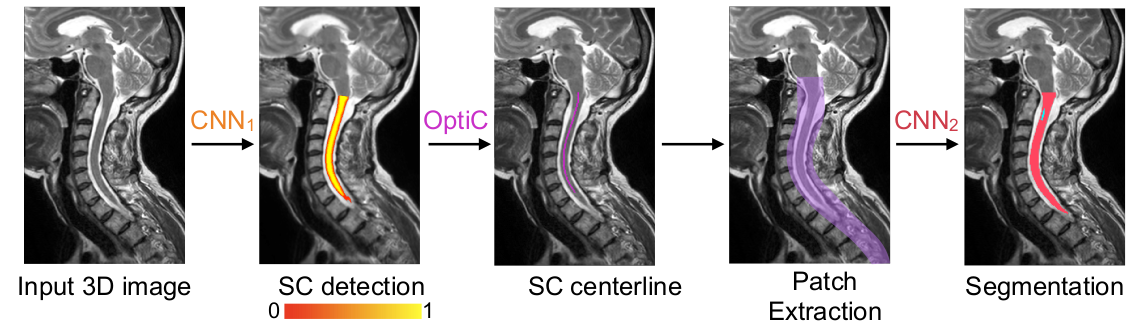
As its name suggests, sct_deepseg_sc is based on deep learning. It is a newer algorithm, having been introduced to SCT in 2018. The steps of the algorithm are as follows:
1. Spinal cord detection
First, a convolutional neural network is used to generate a probablistic heatmap for the location of the spinal cord.
2. Centerline detection
The heatmap is then fed into the OptiC algorithm to detect the spinal cord centerline.
3. Patch extraction
The spinal cord centerline is used to extract a patch from the image. (This is done to exclude regions that we are certain do not contain the spinal cord.)
4. Segmentation
Lastly, a second convolutional neural network is applied to the extracted patch to segment the spinal cord.
Fixing a failed sct_deepseg_sc segmentation
Due to contrast variations in MR imaging protocols, the contrast between the spinal cord and the cerebro-spinal fluid (CSF) can differ between MR volumes. Therefore, the segmentation method may fail sometimes in presence of artifacts, low contrast, etc.
You have several options if the segmentation fails:
Change the kernel size from 2D to 3D using the
-kernelargument.Change the centerline detection method using the
-centerlineargument.Try the newest segmentation method that is robust to many contrasts: (sct_deepseg)
Try the legacy segmentation method based on mesh propagation: (sct_propseg)
Check the specialized models in sct_deepseg to see if one fits your use case.
Manually correct the segmentation.
Ask for help on the SCT forum.